
HOTG via ANSRVR · every Thursday from 0000Z
#APRSThursday, in one room
The busiest net on ANSRVR runs all day and lands in your packet log the same way everything else does, interleaved with beacons, telemetry and passing traffic. APRS Connect gathers it into a single thread instead: the check-in clock at the top, the roster underneath, and every post in the order it arrived.


Free to install and use over APRS-IS, nets included. APRS Connect Pro adds radio links, offline maps and more, with a 7-day free trial.
The room
A net room is an ordinary conversation thread, except that it collects a whole ANSRVR group rather than one station. Posts are attributed to the operator who sent them, so a relay reads as the person who wrote it and not as the bot that carried it. An RF/internet toggle sits at the top if you want to see only what came in off the air.
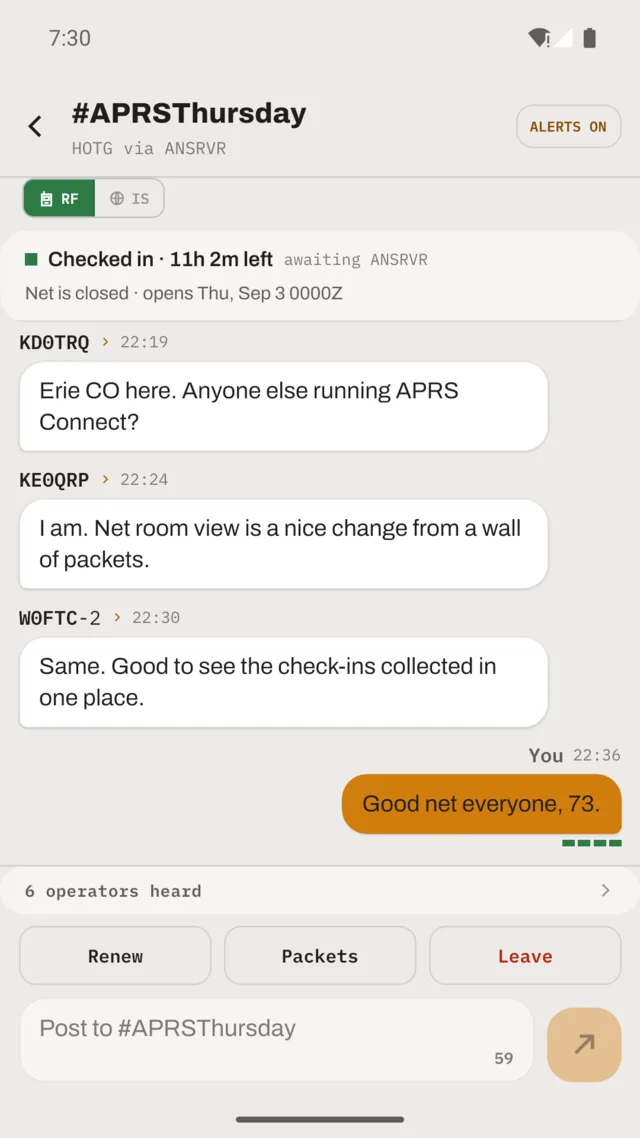
Check in, and stay checked in
An ANSRVR subscription lasts twelve hours. That is ANSRVR's rule, not the app's, and it means a net that runs a full day outlasts a single check-in. The room shows what state you are actually in: Checked in with the time remaining, and a renewal that has been sent but not yet acknowledged says exactly that rather than claiming success it cannot see. Renew holds the subscription for another twelve hours; Leave unsubscribes, and both report their own send status, because APRS gives you no other way to know.
Who has been heard
The room says how many operators are on the net right now, and how old that count is, rather than presenting a stale number as current. The roster underneath lists who they are and how many posts each has made. It covers the current check-in only, which matters for a weekly net running into the same room week after week: last week's roster is not this week's, and checking in again starts the list over.
To keep track of somebody, pin them with the star on their station page. A pinned station sorts to the top of your list whatever order it is in, and while you are on APRS-IS its packets reach you wherever it goes, without it having to sit inside your range filter. It changes where a station sorts, not whether it has been heard: a pin never notifies and does nothing in the background.
The locator the net asks for
Check-ins carry grid squares like JN96bv, EM88bu or
FN03, and the phone already knows yours. The
Grid square screen shows your six-character Maidenhead locator large
enough to read out, with a COPY button beside it and the place it
covers underneath. Below that, the distance and bearing from you to any other locator,
or to any callsign this install has heard.
It is all worked out on the phone: no account, no lookup service, nothing sent anywhere, and it still works with the radio off and no signal. Grid squares has the detail. Free, like the rest of the net side.
Logged on the net list
#APRSThursday keeps a published log through APRSPH, the net's logger, which is also in the app's service directory. When APRSPH confirms your check-in the room says Logged on the net list, so you can see you are on the published log rather than assuming it. APRSPH also accepts a quiet check-in that is logged without relaying to the whole group, and the room shows that as its own state so it doesn't read as a check-in that failed.
And the rest of it
Nets are one thread kind among several. The app also does direct messaging with per-message delivery state, the APRS service bots as guided screens, a vector map with downloadable offline regions, a searchable packet log, and radio links over Bluetooth, BLE, USB, TCP or a built-in audio modem. With Pro, the phone can also run as an IGate or a fill-in digipeater itself. The features page lists all of it, and Groups & nets covers this screen in full.