Mobiles nearby: an alert when a moving station comes into range
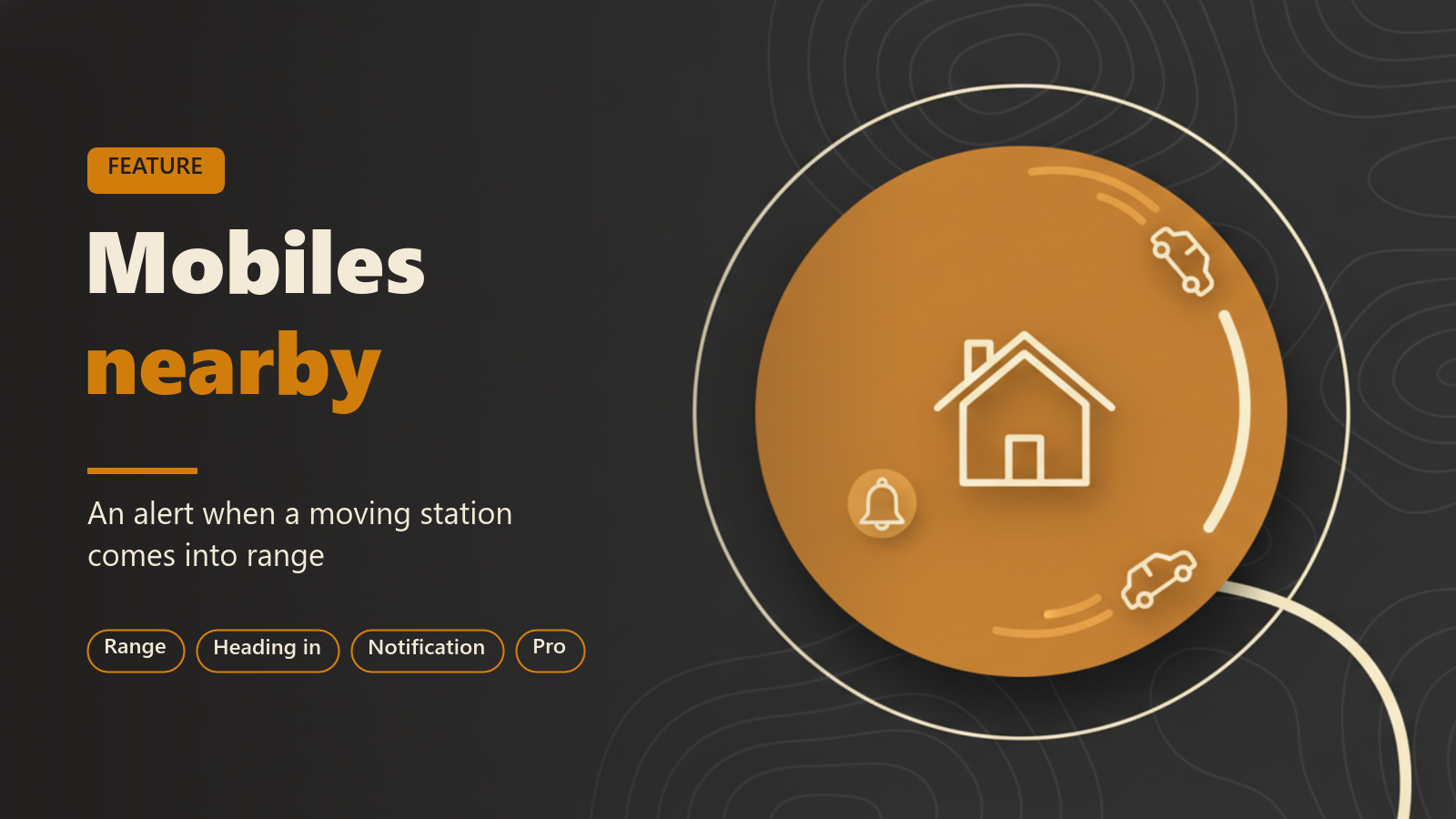
This post is for operators who run APRS from a vehicle and would like to know when another moving station is close enough to call on voice. It describes the Mobiles nearby feature in APRS Connect: what it treats as a mobile, how it decides a station is in range or about to be, the two settings that shape it, and the cases where it stays silent.
Mobiles nearby is part of APRS Connect Pro. Seeing moving stations on the map and in the Stations tab is free; the notification and the list of qualifying stations are what Pro adds.
What the feature is for
Mobiles nearby tells you when a station that is moving comes close enough to be worth calling. It is meant for driving: another operator meeting you on the same road, coming up behind you, or travelling along a road a mile or two over.
The feature is built for use in a vehicle. Reading or operating a phone while driving is dangerous and in most places illegal. Set the range before you leave, and pull over somewhere safe before you look at an alert.
What counts as a mobile
A station must be reporting a speed above about 6 mph. That threshold is what keeps digipeaters, igates, weather stations and home stations out of the alerts.
The test is the reported speed, not the station's symbol. A mobile running whatever symbol its radio shipped with still counts, and a fixed station that has chosen a car symbol does not. A station that reports no speed at all does not count either.
The range, and what "heading into range" means
The range is a circle around your own position, set in your own units. The default is fifteen miles, which is ordinary simplex range for a mobile.
A station can qualify in two ways, and the app alerts on both:
- In range now. The station is inside the circle. This covers two stations on parallel roads a mile apart, which may never get closer to each other and are workable the whole time.
- Closing. The station is outside the circle but heading in, and will be inside it within the next ten minutes. An oncoming station thirty miles out at highway speed is about seven minutes from being workable.
A station driving away is never alerted on, even at the same distance as one approaching. The app works out whether the gap between you is opening or closing from both stations' reported course and speed, rather than from the current distance alone.
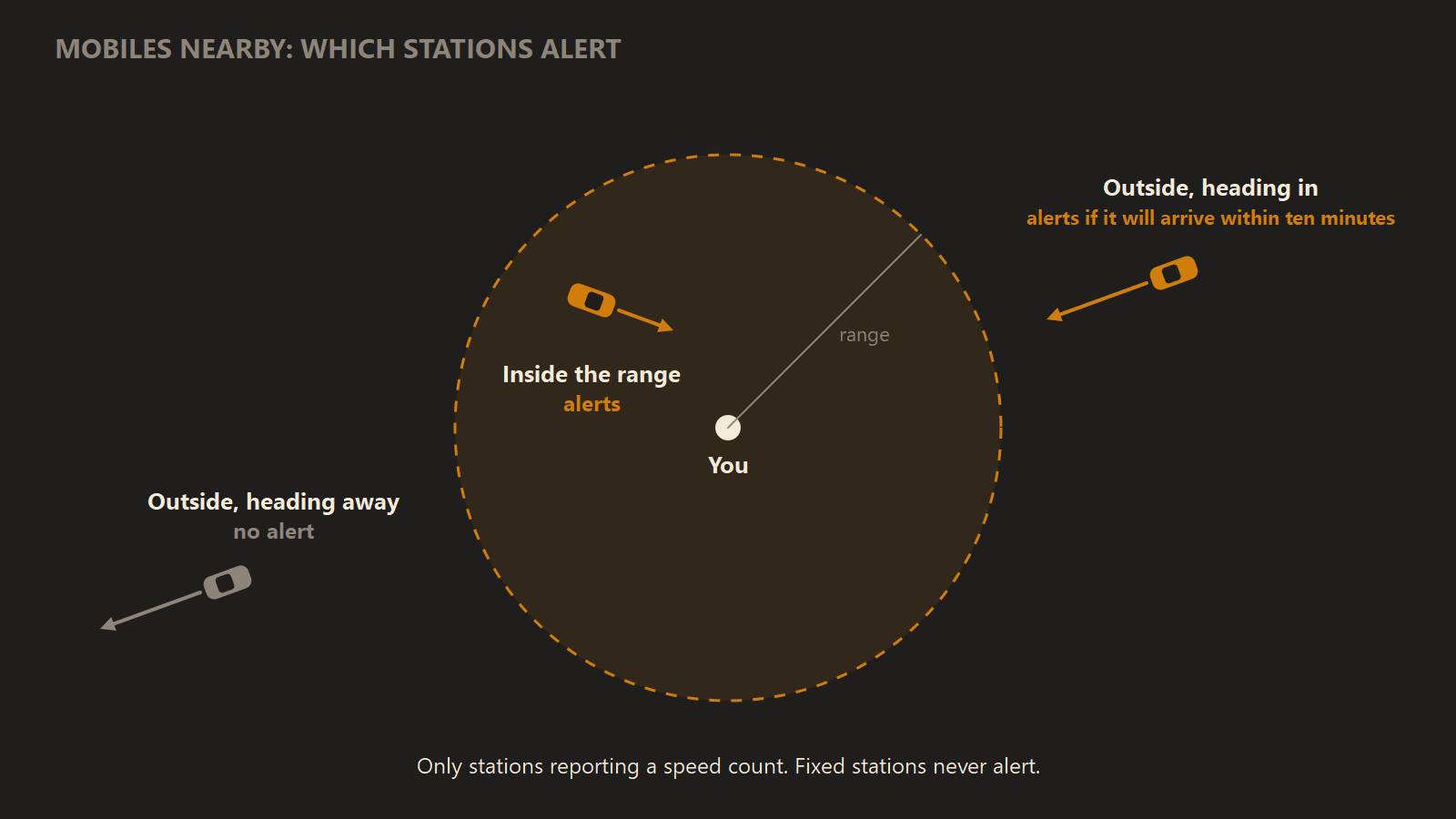
A station inside the range alerts, a station outside it alerts only if it is heading in and will arrive within ten minutes, and a station heading away never alerts.
The frequency filter
Many mobiles put their voice frequency in the position comment or the status, for example 146.520MHz T088. The frequency filter has two settings:
| Setting | What it does |
|---|---|
| Any | Alerts on every moving station in range, whether or not it publishes a frequency. |
| With one | Alerts only on stations advertising a frequency. |
With either setting, a published frequency appears on the notification and in the list, with the tone if the station sent one.
The app is deliberately strict about what it reads as a frequency. A bare number such as 146.520 with no unit after it is not read as one, because comments also carry version numbers, voltages and temperatures that look the same. 000.000MHz is not read as a frequency either, since that is what a radio sends when no frequency is set.
The Mobiles nearby screen
Mobiles nearby is a tile in the drawer, which you open by swiping up on the tab bar. While the alerts are off, that screen shows the controls themselves: the switch, the range, and the frequency filter. Once the alerts are on, it becomes the list of qualifying stations and keeps an Alert settings link back to the controls.
The list is never capped. It shows every station that qualifies, whether or not that station produced a notification. If your own position is more than a minute old, the list shows nothing rather than an answer based on a stale position.
How the notification behaves
There is one alert per encounter, not one per beacon. A station travelling alongside you for an hour produces one notification. If it drops out of range and comes back later, it alerts again.
There is also a ceiling of six alerts an hour, because on a busy road near a city the circle can hold a dozen mobiles at once. Tapping a notification opens the Mobiles nearby list. On Android the alerts have their own notification channel, so you can silence them in Android's settings without silencing message notifications.
Alerts keep working with the app in the background as long as Keep running in the background is on.
Why a station might not alert
- It is not moving, or it is not reporting a speed.
- Its last position is more than twelve minutes old. The app carries a station forward along its last known course to estimate where it is now, and beyond twelve minutes it stops doing so.
- The app does not know where you are. The alerts need location permission and a recent fix.
- You blocked the station, or it is one of your own SSIDs.
- You never heard it.
The last point depends on how you are connected. Over RF, you hear what your radio hears. Over APRS-IS, the app widens the server filter to cover the area around you while Mobiles nearby is on, so nearby stations arrive even on a receive-only session. A station with no igate coverage that is also out of your radio's reach cannot be seen by the phone at all.
Where to read more
- Mobiles nearby for the full reference, including battery use.
- Connect to APRS-IS for the receive filter and receive-only mode.
- Stations for the Moving row on a station page and the MOBILE station type in the view filter.
- Free and Pro for what needs a subscription.
The Mobiles nearby alerts and list need APRS Connect Pro. Moving stations on the map, their trails and their course and speed are free. If Pro ends, the alerts stop and the list stops filling, and the range and frequency settings are kept as you left them.