Working the ISS digipeater from your phone
This post is for licensed operators who have a 2 m radio, a way to connect it to a phone, and an interest in getting a packet repeated by the International Space Station. It covers what the digipeater is, what equipment it takes, why timing matters, and what APRS Connect does during a pass.
Most of what the app does for the ISS needs APRS Connect Pro. The last section says which parts are free.
The digipeater on the station
The ISS carries an amateur radio packet digipeater, run by ARISS (Amateur Radio on the International Space Station). It listens and transmits on 145.825 MHz, 1200 baud AFSK, worldwide, and repeats any packet whose path asks for it.
It is not always on. The digipeater is switched off during some crew activities, and ARISS publishes the current status of the station's radios on its own site. The ISS screen links to it. The app itself only knows what it has heard.
What you need
You need a radio on 145.825 MHz and a connection between that radio and the phone. In APRS Connect every connection is a channel on the Radio screen, and the radio channel types are a Bluetooth TNC, a Bluetooth LE TNC, a USB TNC, the audio modem and a network TNC. Bluetooth Classic and USB TNCs are Android only. Radio channels need Pro. Connect a radio lists the hardware for each type.
APRS-IS alone does not reach the station, because a packet only gets to the digipeater as RF. The radio has to be on 145.825 MHz, and the app does not tune it.
The path
A packet asks the station to repeat it with the path ARISS, and nothing after it. When the station repeats a packet it writes its own callsign into the path as the used hop, RS0ISS*, the same way a terrestrial digipeater marks WIDE1-1 as used. A packet that still shows ARISS unmarked was not repeated, which is the usual outcome of transmitting at a satellite.
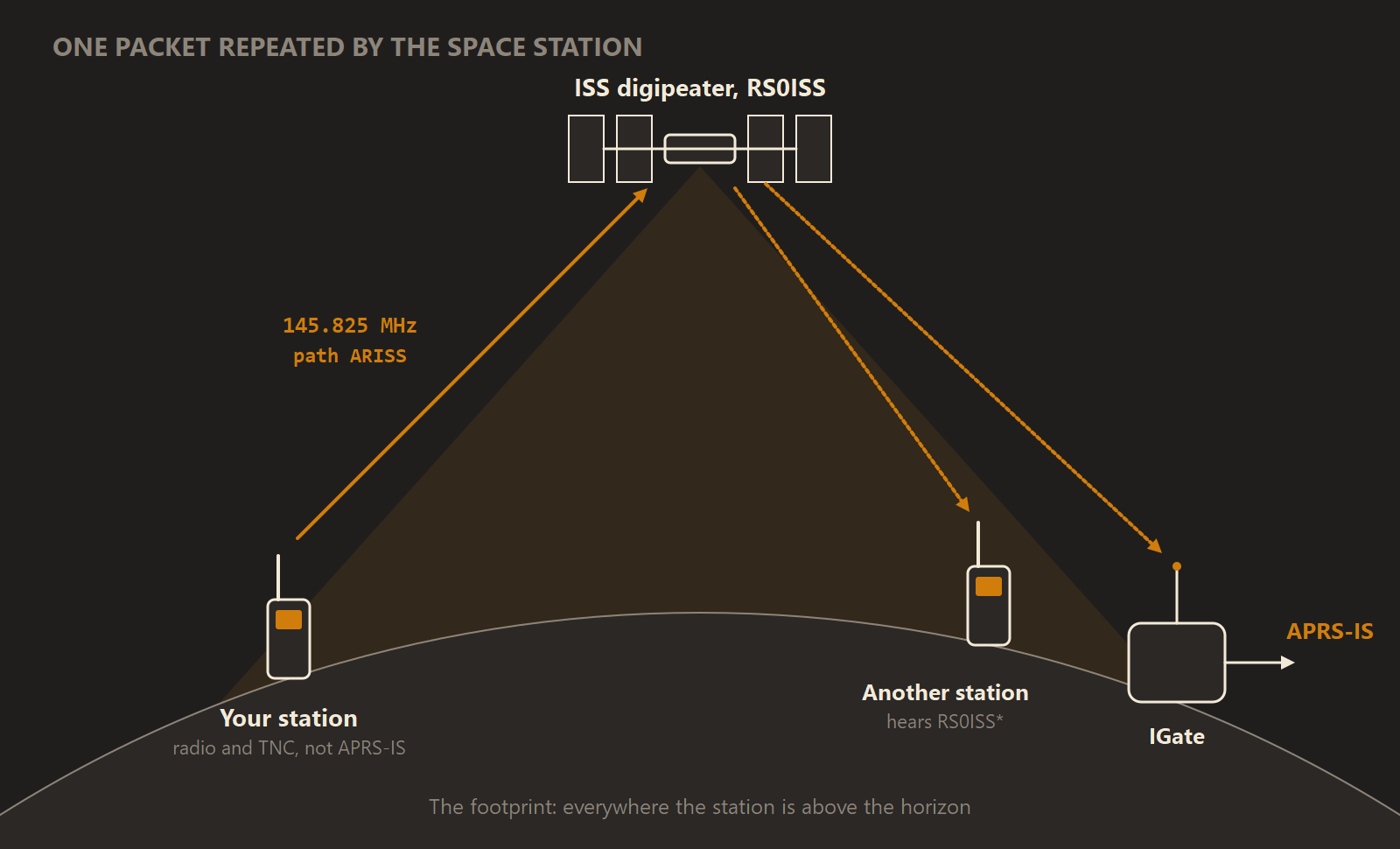
One packet sent up on 145.825 MHz is repeated to every station under the footprint, and an IGate that hears it passes it to APRS-IS.
How short a pass is
A ground station can hear the ISS, and be heard by it, only while the station is above the horizon. A pass lasts about ten minutes, and there are several a day. The app does not list passes that peak under 10° above the horizon, because a handheld does not hear them.
The channel is also shared by every station under the footprint at the same moment, so once a minute is the accepted beacon rate.
Where the station is and the next passes
The ISS screen is in the drawer. It says whether the station is above your horizon right now, how high it stands and in which direction, and where it is over the earth.
The numbers are computed on the phone from a two-line element set from CelesTrak. A fetched orbit is kept and used for days, so the screen works with no signal once it has one.
The screen lists the next three passes over your position: when each starts, how long it lasts, how high it gets and in which direction. Next 5 days of passes opens the rest, grouped by day.
The Space station map layer
Show on the map turns on the Space station layer and centres the map on the station. The layer draws three things:
- the station itself as the APRS satellite symbol, updated every couple of seconds
- the dashed circle of ground from which it is currently above the horizon, which is the area it can hear a packet from
- its ground track for the next orbit
The layer is also in the map's LAYERS panel, off by default.
The ISS beacon
Add ISS beacon creates a beacon profile with the ARISS path, a fixed rate of once a minute, and only your radio channels selected, then opens it in the editor. It is created switched off.
Send during passes is the switch that sends it. With it on, the beacon goes out once a minute while the orbit puts the station above your horizon, and whenever anything the station repeated is heard on your radio. Nothing is sent between passes, and the profile itself stays switched off.
A message held for the next pass
Long-press any outbound message that has not been answered and choose Send via the ISS. The app stops sending it on the ground and holds it. When the station is next heard on your radio, the message goes out with the ARISS path, over the radio only, on the usual retry schedule.
If that pass does not deliver it, the next pass gets another try, three in all over two weeks. The Waiting to be heard screen lists the message with a VIA ISS mark, and Stop waiting lets it go.
Pass notifications
Every pass in the list has a Notify button that asks for a notification before that one pass. Every pass does the same for all passes that fit two limits: Only above sets the peak elevation a pass has to reach (10°, 20°, 30° or 45°), and Between sets the local times of day you are willing to be notified in.
Minutes before a pass sets how far ahead the notification comes: 2, 5, 10, 15 or 30 minutes, with 5 the default. Notifications are off by default, and they fire whether or not the app is running.
Stations heard through it
The bottom of the ISS screen lists every station whose packets the ISS has repeated, taken from the packet log, newest first, with a count and when each was last heard. Only a packet that came back down counts, and the list reaches back as far as the packet log is kept.
In the packet log, each packet the station repeated carries a VIA ISS tag in the left-hand gutter, and a Via ISS chip collects them once the log holds one. A station's page gains a Via ISS row once it has been heard that way, and the view filter has a VIA ISS chip under Show only.
Where to read more
Everything described here except the VIA ISS mark in the packet log, the Via ISS row on a station's page and the VIA ISS filter chip needs APRS Connect Pro, and so do radio channels. See Free and Pro.